Research
Perso-Islamic Eurasia and the Russian Empire
My research focuses on Eurasia’s “even longer” nineteenth century, but I am interested in enduring continuities connecting this period both to pre-Islamic antiquity and to the Soviet aftermath. My thematic foci are comparative colonialism, sovereignty, and indirect rule: how power operates where formal authority and actual control come apart. I consider my work equally part of Islamic, Russian, Persianate, Central Asian, and — increasingly — South Asian studies.
Polymaths of Islam
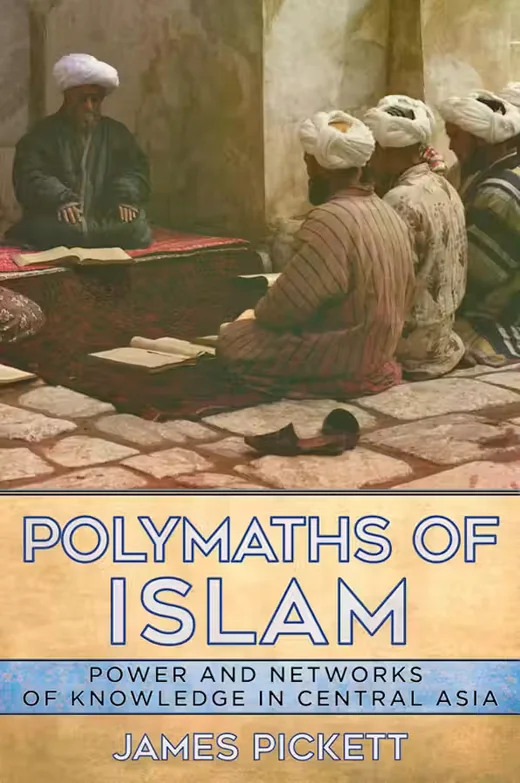
Polymaths of Islam: Power and Networks of Knowledge in Central Asia (Cornell University Press, 2020) is a social and cultural history of Islamic scholars in Bukhara. Its subjects were men who made themselves indispensable by mastering everything at once — jurisprudence, medicine, astrology, poetry, the art of the chancery — and who converted that breadth into political power. The book argues that this scholarly class, not the dynasty, is what made Bukhara a peerless center of Islam.
There is a superb discussion of its arguments at Islamicate Book Reviews and an in-depth interview with me on the New Books Network, as well as scholarly reviews in academic journals. Related work has appeared in the International Journal of Middle East Studies (2016), the Journal of Persianate Studies (2016), and in the anthology Islamic Ecumene: Comparing Muslim Societies (2023).
Russian Subject, Muslim Monarch
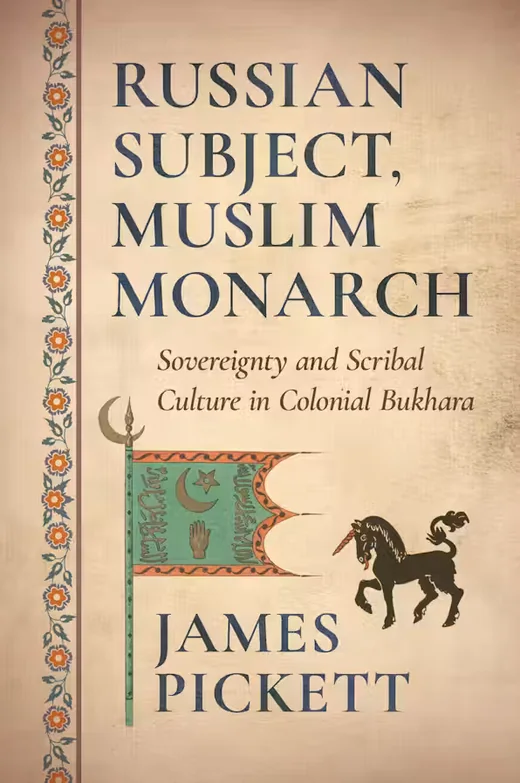
Russian Subject, Muslim Monarch: Sovereignty and Scribal Culture in Colonial Bukhara (Cornell University Press, 2026) is about what sovereignty looks like when you follow the paperwork. Bukhara was functionally a protectorate of the Russian Empire from 1868 to 1920, which made it resemble a directly ruled colonial province. But it also kept a working Persianate chancery and a cultural life entirely separate from Russia, which made it simultaneously a Perso-Islamic state.
The book examines the intersection of those paradoxical realities. Between 1885 and 1920 Bukhara’s chancery exchanged documents with colonial Russian authorities constantly, and bridging the conceptual gap between the two worlds required Bukharan scribes to command both the Islamic literary arts and an encyclopedic knowledge of colonial Russian society. Because the chancery had to process the messy business of actually governing people, its records preserve figures the literary tradition wrote out — women navigating patriarchal courts, religious minorities seeking state protection, ordinary subjects petitioning for justice.
Seeing Like a Princely State
I conceive Russian Subject, Muslim Monarch as part of a larger agenda on sovereignty and cultures of documentation in Persianate Eurasia. Future research will place Bukhara in direct comparison with the Indian princely state of Hyderabad, similarly a Perso-Islamic polity under colonial “protection” in the form of a British resident.
An article in the American Historical Review (2018) lays the groundwork by exploring sovereignty in Eurasia during the precolonial period; an introduction co-authored with Paolo Sartori to a theme issue of the Journal of the Economic and Social History of the Orient (2019) argues for a new approach to the study of Islamic documents.
Side projects
These interests have led me toward a number of more self-contained projects. I have written about the Soviet legacy of the Persianate cultural sphere, and investigated the implications of Central Asian history for teaching the Persian and Turkic languages of the region, for both a scholarly and a popular audience. More recently I contributed a synthetic Cambridge History chapter on Persianate migration (building on my contribution to Asia Inside Out), and an overview of Central Asian history in the eighteenth and nineteenth centuries. With Jessica Pickett, I have also assembled new archival evidence on the “Russian Influenza” of 1889 as it reached Bukhara — a working paper, circulated for comment.